Treatment
Hip Replacement
A total hip replacement is one of the most successful operations in modern medicine. It reliably relieves arthritic pain, restores movement and allows patients to return to the activities they enjoy.
When is a hip replacement right for me?
Surgery is considered when hip pain limits your walking, disturbs your sleep, or stops you doing the things you love, and when non-surgical measures such as physiotherapy, activity modification, weight management and painkillers no longer provide enough relief. Paddy Subramanian will only recommend surgery once you have explored the alternatives together and you feel ready.
The procedure
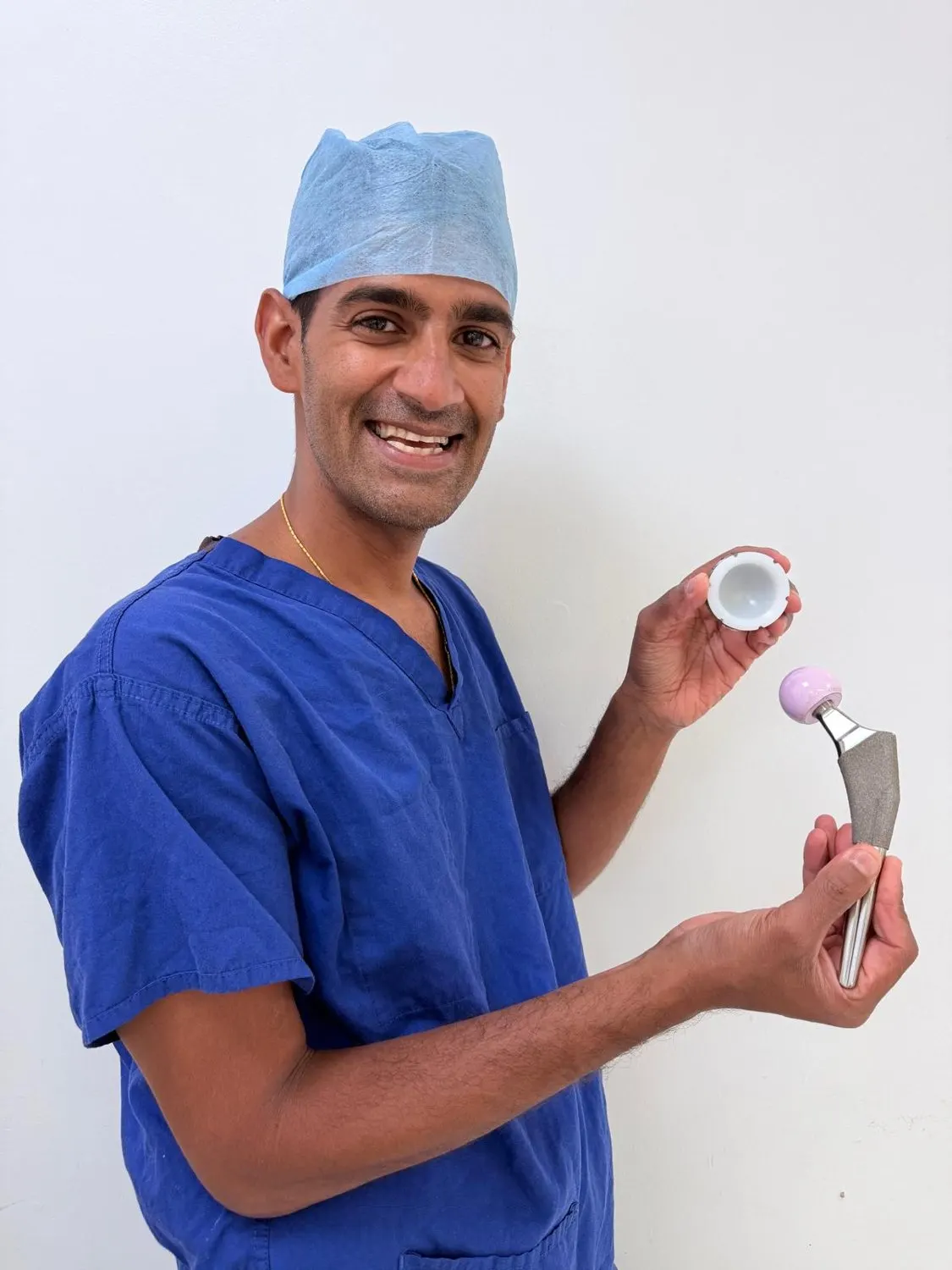
The worn ball and socket are replaced with a highly polished femoral head and a durable acetabular bearing. Paddy Subramanian uses a muscle-sparing approach with modern, registry-proven implants selected for your bone quality, age and activity level. Surgery usually takes 60 to 90 minutes and is most often performed under spinal anaesthetic with sedation.
The anterior approach: muscle-sparing surgery
Paddy Subramanian offers the direct anterior approach to hip replacement. The hip is reached from the front, through a natural interval between the muscles, so muscle attachments are not routinely detached, which can help some patients reach early walking milestones sooner and complements the day-case pathway. For suitable patients he also performs the bikini incision, a short skin incision along the natural skin crease at the front of the hip that leaves a more discreet scar. Long-term results of the established approaches are generally similar, and the right choice depends on your anatomy and individual needs, decided together at your consultation.
Your recovery
Most patients stand and walk with a physiotherapist on the day of surgery and go home the same day or after an overnight stay. You will walk with crutches for two to three weeks, return to desk-based work within four weeks, and can usually drive again from around six weeks. Sport, golf and cycling typically resume between three and six months.
Read more before you decide
- Hip Replacement Recovery GuideWhat to expect week by week after a hip replacement, from the day of surgery to driving and work.
- Anterior Approach Hip ReplacementThe muscle-sparing approach through the front of the hip, and who it suits.
- Hip Replacement Cost GuideWhat a private hip replacement costs and what the package covers.
- How Long Does a Hip or Knee Replacement Last?What the latest registry evidence says about how long a replacement lasts.
Three approaches, one replacement: a one-minute guide
This short silent animation explains what happens to the muscles around your hip with each surgical approach, and why the muscle-sparing direct anterior approach, offered by Paddy Subramanian, preserves the muscle attachments. Captions are built into the video; a written transcript is below.
Read the transcript
Three approaches. One replacement. What happens to the muscles around your hip? Direct anterior: between muscles. Conventional posterior: short tendon release and repair. Direct lateral: partial abductor release and repair.
Direct anterior: from the front, through a natural interval between muscles. Muscle attachments are not routinely detached. The capsule and other tissues still need to be opened, and additional releases are sometimes needed.
Conventional posterior: from the back. Gluteus maximus fibres are split in their direction, and the short rotator tendons are usually released, then repaired. The main abductor attachment is preserved.
Direct lateral: from the side. The anterior portion of the abductor attachment is released and repaired; most of the attachment is preserved. The abductors keep the pelvis level when walking, and their repair needs time to heal.
The takeaway: the anterior approach preserves important muscle attachments and may help some early walking milestones. Longer-term results are generally similar across established approaches, and all involve tissue healing and risks. The right choice depends on your individual needs. Discuss the options with your surgeon.

Dr Subramanian has been approachable, professional and allowed me to consider what is a major surgery with confidence. All my questions were answered and I felt involved in the decision making. I am now back on my feet with a neat scar. I would recommend him highly to anyone.
Verified Patient
Hip Replacement, Doctify (August 2026)
Patient Testimonials
Back to the life you had before the pain.
Every patient's experience matters. These are the words of people who came in unable to walk comfortably and left able to get back to their families, their work and their sport.
Read More TestimonialsTake the first step today
Living with hip or knee pain does not have to be permanent. Book a consultation and find out exactly what is wrong, what your options are, and what life could look like without the pain.